Why overflowing gutters are such a common problem
Water pouring over the edge of a gutter is one of the most frequent complaints from homeowners. It looks alarming, and it often happens in the worst weather. However, the cause is usually one of a small set of faults.
Finding the right one early matters. A simple blockage costs little to fix. If you ignore it, though, the same water can soak walls and strain the fixings. So it pays to work out what is happening before you call anyone.
This guide goes through the five usual causes. It also shows how to tell them apart from the ground, and what each one needs.
Cause 1: a blocked gutter
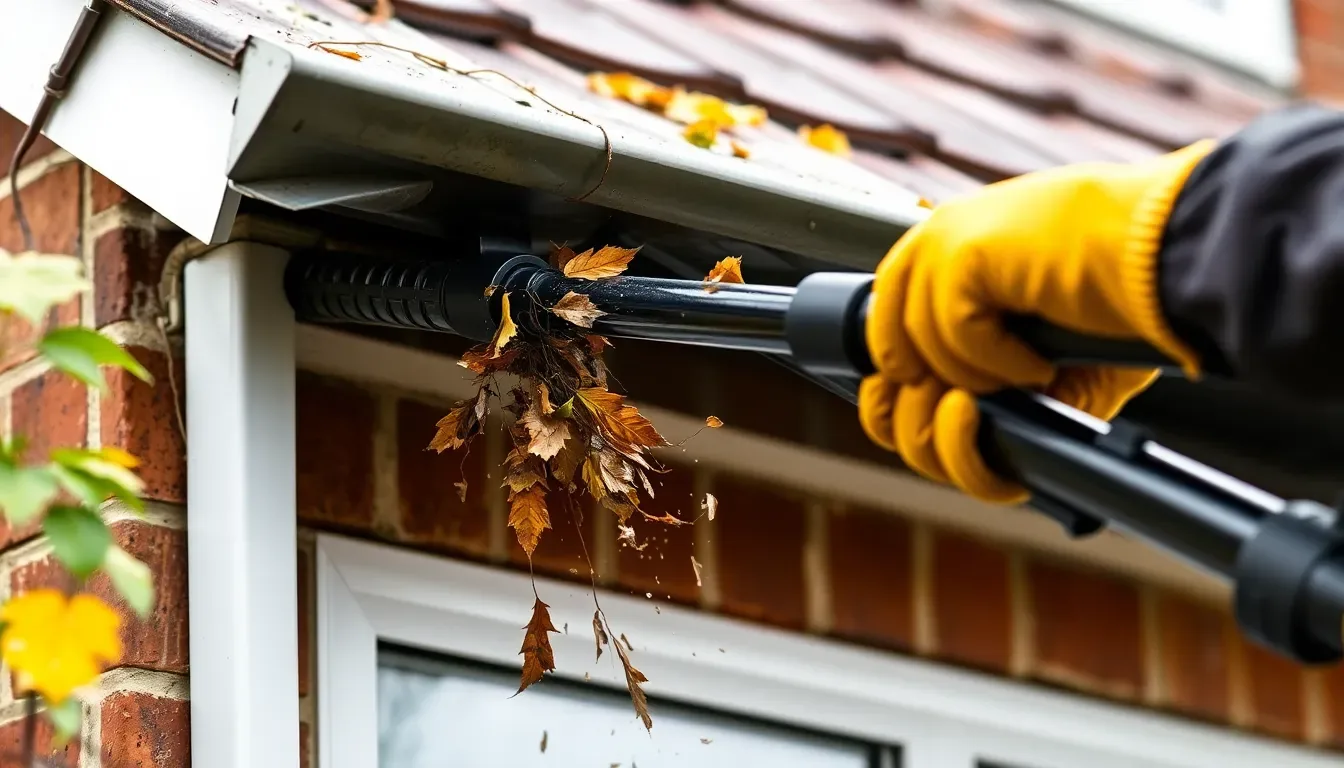
The most common trigger is a build-up of leaves, twigs, moss and silt. After autumn, or near big trees, the debris piles up quickly. Over time it packs down and stops water reaching the outlet.
Once that happens, the water has nowhere to go but over the lip. You often see it spill at the front during a heavy downpour. Because the debris is wet, it also weighs far more than it looks.
A clean fixes this cause. Our gutter cleaning service clears the whole run with a ground-based vacuum system, and we clear downpipes as part of a clean.
Cause 2: too little fall
Gutters are fitted with a slight slope so that water runs toward the outlet. If the fall is too shallow, water lingers in the run. Brackets can also shift with age and flatten the slope.
A gutter with a poor fall can look clear and still overflow. Silt settles in the low spot, and then weeds take root. So you may see a green patch in the middle of the run, far from the downpipe.
This is a repair job, not a cleaning job. Brackets need to be moved so the water drains again. Our gutter repair service covers this kind of fix.
Cause 3: a blocked or damaged downpipe
Even a spotless gutter will overflow if the downpipe is blocked. Nests, grit and compacted leaves are common culprits. A branch can also crush a section.
Here is a clue. If water backs up at the outlet, or you hear gurgling, look at the downpipe first. Water then spills out of the top because it cannot escape below.
A blocked pipe often needs clearing from the outlet end. A crushed one needs a new section. In either case, a clean alone may not be enough.
Cause 4: a sagging or detached gutter
Loose brackets or a rotten fascia let the gutter pull away from the roofline. The low point then becomes a spill point, often nowhere near the downpipe. You can usually see a gap between the gutter and the board behind it.
Wet debris makes this worse, because it adds weight. For this reason, a sagging run is often a sign of an old blockage. Our guide on repairing guttering without replacing it explains the common fixes.
Cause 5: a failed joint or seal
Older systems, and cast-iron runs in particular, rely on sealed joints. The seal can crack, or the joint can open up. Water then escapes at one point instead of flowing on.
This looks like an overflow, but it is really a leak. The wall below the joint is often stained, or you see a steady drip in dry weather. If your joint is the issue, our post on how to choose a gutter sealant may help.
Quick guide to the causes
| Cause | What you see | Likely remedy |
|---|---|---|
| Debris build-up | Packed material in the channel | Clean the run and clear the downpipe |
| Poor fall | Standing water in a clear gutter | Adjust the brackets |
| Downpipe blockage | Water backing up at the outlet | Clear or replace the pipe |
| Sagging gutter | A gap between gutter and fascia | Repair the brackets |
| Joint failure | A drip or a stain at one joint | Reseal or replace the section |
Why it matters beyond the nuisance
Water that keeps running down a wall is a common cause of damp indoors. Constantly wet brickwork can also suffer over several seasons. As a result, dealing with an overflow early protects the building.
There is a cost angle as well. A small fault that is fixed early is cheaper than a wall that needs drying out. Our post on gutter cleaning cost explains how quotes are built up.
Checking safely from the ground
You do not need to climb to learn a lot. Stand back from the house in steady rain and watch the gutter line. Then note where the water leaves the run, and whether it falls straight down or runs along the wall.
Avoid leaning a ladder against the gutter itself. Plastic gutters can crack under that load, and the fixings may not hold your weight. Instead, use a camera on a pole, binoculars or a phone on a long handle to look inside. If you cannot see the problem, that is a good reason to ask a professional.
What to do next
First, look at the gutter from the ground during rain. Note where the water spills, because the spot tells you a lot. Then check the downpipe base for a trickle.
If the cause is leaves, plan a clean and read our autumn gutter guide for timing. Also, our guide on how often to clean gutters helps you set a routine. If leaves are a constant problem, you might wonder about gutter guards in Kent. Guards reduce the work but do not end it.
If the run is beyond a repair, read about gutter replacement cost before you decide. Landlords should also see our guide to gutter cleaning for landlords, because repair duties can fall on the owner. To understand the cleaning method, see what a gutter vac is.
Where we work
We serve Maidstone and mid-Kent. Local pages include gutter cleaning in Maidstone, gutter cleaning in Sittingbourne, gutter cleaning in Faversham and gutter cleaning in West Malling.
Get a clear answer
Our hours are Monday to Saturday, 8am to 6pm. A quote is free and carries no obligation. When you are ready, send your details through the contact form and we will advise on the next step.
Tags:
Related Articles
Gutter Cleaning for Landlords: What the Law Says
Are landlords responsible for gutters? See what the Landlord and Tenant Act 1985 s.11 and GOV.UK say about gutters, and how to plan upkeep for rental homes.
Tips & AdviceAre Gutter Guards Worth It? An Honest Look for Kent Homes
Do gutter guards stop you cleaning your gutters? Learn what leaf guards do well, where they fall short, and which homes gain the most before you decide to buy.